
Tippah County Parole and Probation
Parole and probation can both place a person in the community under rules, but the legal source is different. The Mississippi State Parole Board decides whether to grant or revoke parole. MDOC Community Corrections then supervises a parolee. Probation is ordered by a circuit judge as an alternative to, or part of, a sentence. The order and court docket are the durable sources for probation, while MDOC's public parole search is the best first check for current parole.
Other labels matter. Earned Release Supervision, usually shortened to ERS, is a statutory form of conditional release administered by MDOC. A person on ERS lives outside a prison but retains inmate status and remains under MDOC jurisdiction until sentence expiration. Intensive Supervision Program placement, often called ISP or house arrest, is another community status. None should be treated as a synonym for unconditional discharge.
| Supervision type | Who authorizes it | Best verification source |
|---|---|---|
| Parole | Mississippi State Parole Board | MDOC Parolee Search, then Community Corrections |
| Probation | Sentencing court | Court order or docket, then Community Corrections |
| ERS | Mississippi law and MDOC calculation | MDOC Records or discharge and sentence records |
| ISP or house arrest | Court or MDOC under the applicable authority | Official placement record and Community Corrections |
- Parole
- Conditional community release before the full sentence expires.
- Probation
- Court-ordered supervision that may replace or follow confinement.
- Discharge
- The documented end of the identified sentence or supervision term.
- Absconder
- A formal supervision status, not a label that can be inferred from a missing search result.
Verify Tippah Post-Release Supervision
The MDOC Parolee Search is separate from the state inmate search. It accepts a first and last name or MDOC number and permits city or county filters. A result can display a photo, MDOC identifier, date of birth, county, supervising officer, and Flat Time Date. Compare several identifiers. Common names and old locations can produce the wrong match.
A positive result supports current conditional parole or community status. It does not prove the sentence is complete. Flat Time Date is a sentence-related field, not necessarily the day the person left Tippah County Jail. Probation, ERS, ISP, and completed supervision may need a court record or central MDOC record because they may not appear under the label a searcher expects.
- Search the exact name in the MDOC Parolee Search. Use the MDOC number when known.
- Narrow by Tippah County or Ripley only after checking spelling and identifiers.
- Open the detail and compare date of birth, photograph, MDOC number, county, and supervising officer.
- Call the Tippah Probation & Parole Office to confirm local routing. Do not ask for privileged field notes.
- For probation, obtain the sentencing or amended order from the court of origin. For final discharge, request the nonexempt MDOC or court record.
The public result layout can be checked on the official MDOC parolee search before interpreting a match.
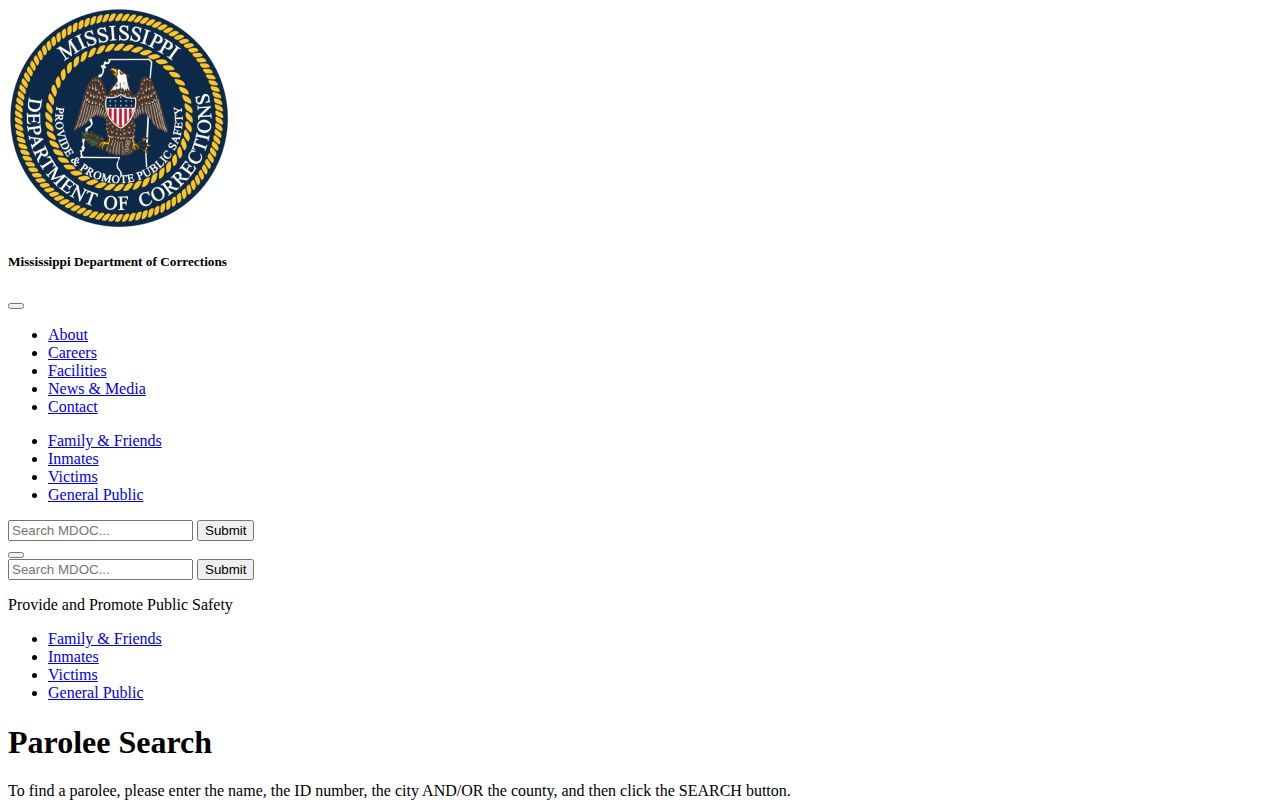
The screen confirms which search fields MDOC currently exposes. The underlying agency record remains the source for a person's actual supervision status.
Tippah County Supervision Office
Tippah County has a local MDOC Community Corrections location. It is a supervision office, not a jail and not a substitute for the sheriff's bookout record. A released state prisoner may report there for parole or another MDOC community placement. An ordinary county detainee who leaves the jail is not proven to be on supervision merely because the office exists.
Tippah Probation & Parole Office102-A North Main Street
Ripley, MS 38663
Phone: 662-837-2107
Hours: Not published; call before visiting
Use the office for local supervision routing after a sound identity match. The public facility page names the office and phone, but it does not publish reporting instructions or walk-in hours. Reporting directions are person-specific and should come from the officer or official paperwork.
Important: A Tippah County Jail bookout can be a transfer to MDOC, another county, or another agency. It is not automatically parole.
Tippah Supervision Violations and Warrants
Supervision conditions come from the controlling order, certificate, or MDOC instructions. At a high level, a person may have reporting, travel, residence, or conduct terms. The exact terms must not be guessed from a public search. A suspected violation may lead to review, a warrant, arrest, or revocation proceedings, but one missed appointment is not public proof of any specific outcome.
No official statewide MDOC absconder database or Tippah-specific absconder list was located in the research. Therefore, an empty Parolee Search result cannot support an absconder claim. It may reflect completed supervision, probation rather than parole, a spelling mismatch, a record transition, or no MDOC involvement. Verify a warrant with the proper court or law-enforcement source and ask Community Corrections only for information it can lawfully release.
Mississippi law treats field-agent information as privileged under §47-7-21. A records request should seek central, nonexempt status or discharge material rather than private officer notes. Mississippi SAVIN/VINE can report some supervision changes, including absconding events supplied by participating sources, but an alert still needs agency confirmation.
Note: A public-search absence is inconclusive and must never be converted into a claim that a Tippah County person violated supervision.
Tippah Parole Decisions and Release
The Mississippi State Parole Board has exclusive power to grant and revoke parole. MDOC calculates eligibility, manages custody, and supervises people after release. Eligibility permits consideration only. A grant is conditional approval, and physical release may still depend on residence approval, detainer resolution, certification, and other required steps.
Board hearings are closed to the public and scheduled for individual cases. No public statewide calendar, docket, or results portal was located. Board rules provide written decisions to the offender and to a victim or family through the authorized process. Other disclosure is case-specific. Rule 2.4 also requires a minute-book copy of official action with reasons, so a focused request for a named action or minute is more sound than looking for a nonexistent public results feed.
The Board's office is listed at 239 North Lamar Street, Suite 501, Jackson, with telephone 601-576-3520. Official pages differ on the mailing ZIP. Confirm the address by phone before sending a request. A denied grant means no parole approval at that point; a revocation concerns existing parole. Other outcome words should be used only when the actual Board record uses them.
Tippah Supervision Record Chain
A reliable post-release check often needs three records. First, the Tippah County Sheriff bookout shows when county custody ended and whether the destination was the community or another custodian. Second, a court order or Parole Board action supplies the legal authority. Third, the MDOC supervision or discharge record identifies the current community status and its end. A match in only one source cannot answer all three questions.
When someone disappears from MDOC Inmate Search, try the separate Parolee Search. A parolee result may show conditional community status after prison custody ends. If neither search produces a sound match, central MDOC Records can be asked for nonexempt inactive-master-file or discharge information. Search absence may reflect completed parole, a record transition, spelling variation, or a person who never entered MDOC custody.
Mississippi SAVIN/VINE adds notifications, not a replacement record. It can report transfer, return to custody, release, or supervision absconding events supplied by a participating agency. The Registration Link can follow a county-to-MDOC move. Because automated alerts may lag or repeat, write down the event, time, and source, then confirm with that source. The Sex Offender Registry is separate and applies only to qualifying registrants; it is not a general supervision lookup.
A probation question begins with the court. Tippah Circuit Clerk maintains indictments, criminal papers, judgments, and executions for Circuit Court matters. Request the sentence and any amended, termination, or revocation order. Justice or municipal court records may be relevant when that court is named in the underlying booking. Use the docket to locate authority, not to guess a current field-office status.
Identity checks remain essential across every channel. Compare the full name, date of birth, MDOC number, photograph, county, and supervising officer where available. A Flat Time Date shown on a parolee detail is not necessarily the physical release date from Tippah County Jail. It relates to the sentence record and needs agency context. If dates conflict, ask the office that created each record rather than selecting the most convenient result.
Tippah County Supervision Discharge
Supervision ends through an official discharge, sentence expiration, court action, or another documented authority. The end date is not proven by a person no longer appearing in a live public search. For MDOC records, ask the Records Department for a nonexempt discharge certificate, actual discharge date and authority, and final supervision status. MDOC Records can be reached at P.O. Box 24388, Jackson, MS 39225, by telephone at 601-933-2889, or at MDOCRecordsDepartment@mdoc.state.ms.us.
For probation, request the sentencing order and any termination, revocation, or amended order from the court that imposed supervision. Tippah Circuit Clerk maintains criminal filings and judgments for Circuit Court matters. A sheriff release record answers when Tippah County Jail ended its custody, while a court or MDOC discharge record answers when supervision or a sentence ended. The two events can be far apart.
The broader Tippah County released-inmate search and record process helps confirm the initial jail bookout before supervision is assessed. Keep the sequence clear: custody record, supervision record, then discharge record.